PET Bottle Labeling Adhesive Manufacturer: Choosing the Right Adhesive for Reliable PET Bottle Labelling
Introduction
PET bottles have become a familiar sight across beverage, pharmaceutical, food, personal care and spirits packaging. Their light weight, durability and practical handling make them suitable for large-scale production. Yet a PET bottle creates a particular labelling challenge because the container has a slightly flexible surface. The adhesive must bond securely without causing label movement, wrinkles, bubbles or edge lifting. A visually poor label can weaken shelf presentation even when the packaged product itself remains completely intact.
Selecting a PET bottle labeling adhesive manufacturer therefore involves more than choosing a glue with high adhesive strength. Manufacturers need a formulation that suits the PET surface, label stock, application equipment, line speed, humidity level and storage conditions. The adhesive should also provide consistent coverage and predictable behaviour during production. When these factors work together, the result is a stable label, cleaner packaging and fewer production interruptions.
Adchem Industries has developed a dedicated range of labelling solutions for PET and other packaging substrates. Its website identifies the CL & ADP Series as a labelling adhesive for PET bottles, while the AR & ADG Series is designed for glass and PET. The company states that it has operated since 1984, maintains a modern laboratory and separate R&D unit, and has a production capacity of 4 tonnes per day.
Why PET Bottles Need Specialised Labelling Adhesives
PET is not the same as glass. It is lightweight, slightly flexible and can change shape under pressure or handling. A bottle can also encounter humidity, refrigeration and temperature changes during filling, transport and storage. These conditions place additional demands on the adhesive bond.
A suitable PET labelling adhesive must therefore maintain secure contact between the label and bottle while allowing the packaging line to operate consistently. Poor adhesive selection can contribute to label drift, wrinkles, bubbles, incomplete transfer or peeling at the edges.
Adchem Industries specifically describes the CL & ADP Series as a formulation developed around the surface and flexibility requirements of PET packaging. The company states that the adhesive is designed to bond firmly to PET without cracking, peeling or label lift.
This application-specific approach matters because an adhesive that performs well on rigid glass may not give the same results on flexible PET. Substrate selection should always come before product selection.
What Makes a Good PET Bottle Labelling Adhesive?
The phrase PET bottle labeling adhesive manufacturer should represent more than product supply. A capable adhesive manufacturer should formulate products around actual packaging conditions.
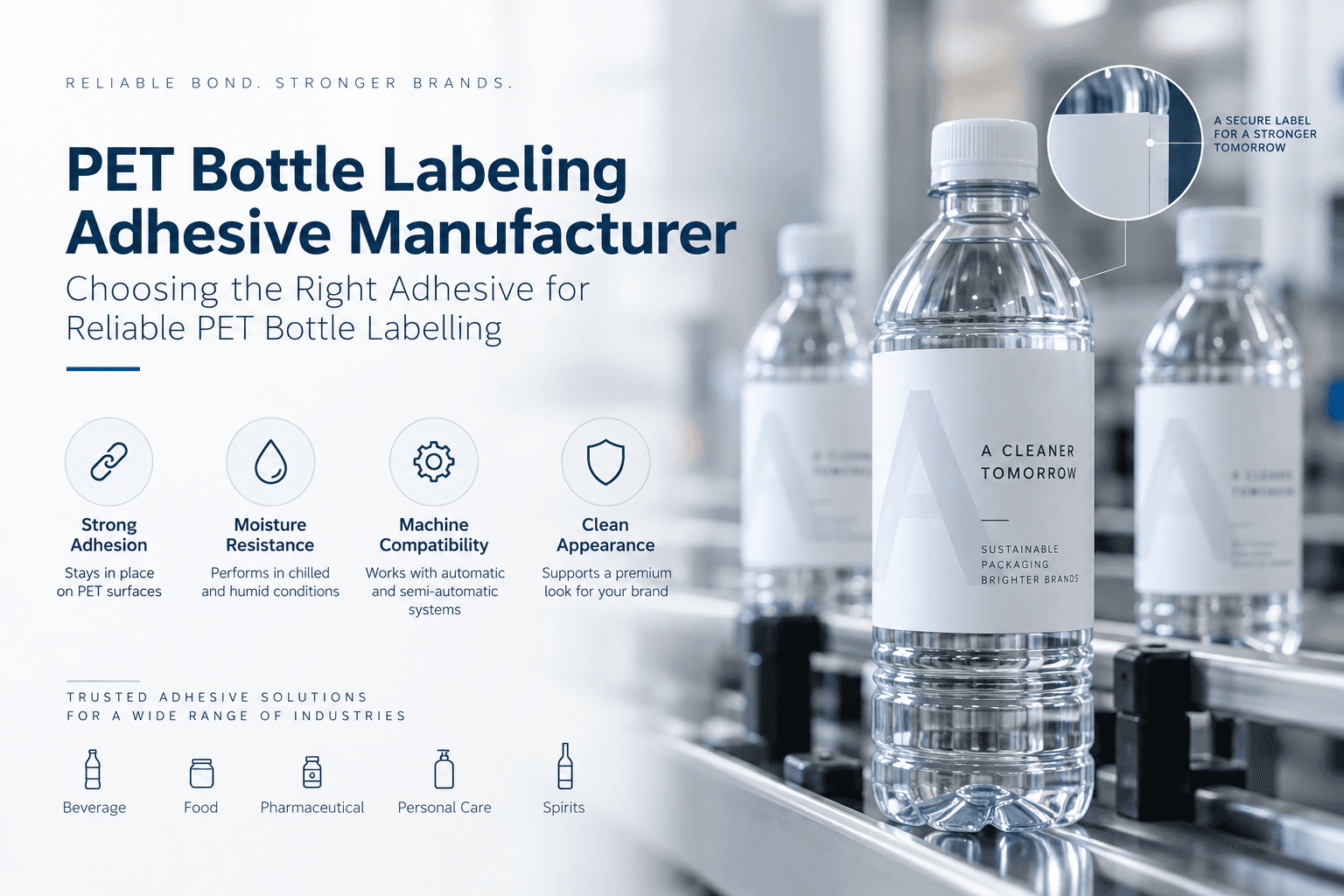
Several characteristics matter during adhesive evaluation. The first is tack, which helps the label hold in its intended position after application. The second is coverage, because the adhesive should spread adequately without unnecessary excess. Moisture resistance also matters when bottles enter chilled distribution or humid storage areas.
Appearance is another critical factor. A colourless or clean-drying formulation can help preserve the visual quality of a printed label. Machine compatibility is equally important because automatic, pump-type, pot-type and semi-automatic systems can have different operating requirements.
Adchem’s CL & ADP Series combines high coverage with a colourless coating, skid-free behaviour, humidity resistance and compatibility with automatic and semi-automatic labelling systems.
CL & ADP Series for PET Bottle Labelling
The CL & ADP Series is one of Adchem Industries’ principal products for PET bottle labelling. The company describes it as an off-white or cream-coloured adhesive developed using modified natural polymer technology and designed for PET packaging across several industries.
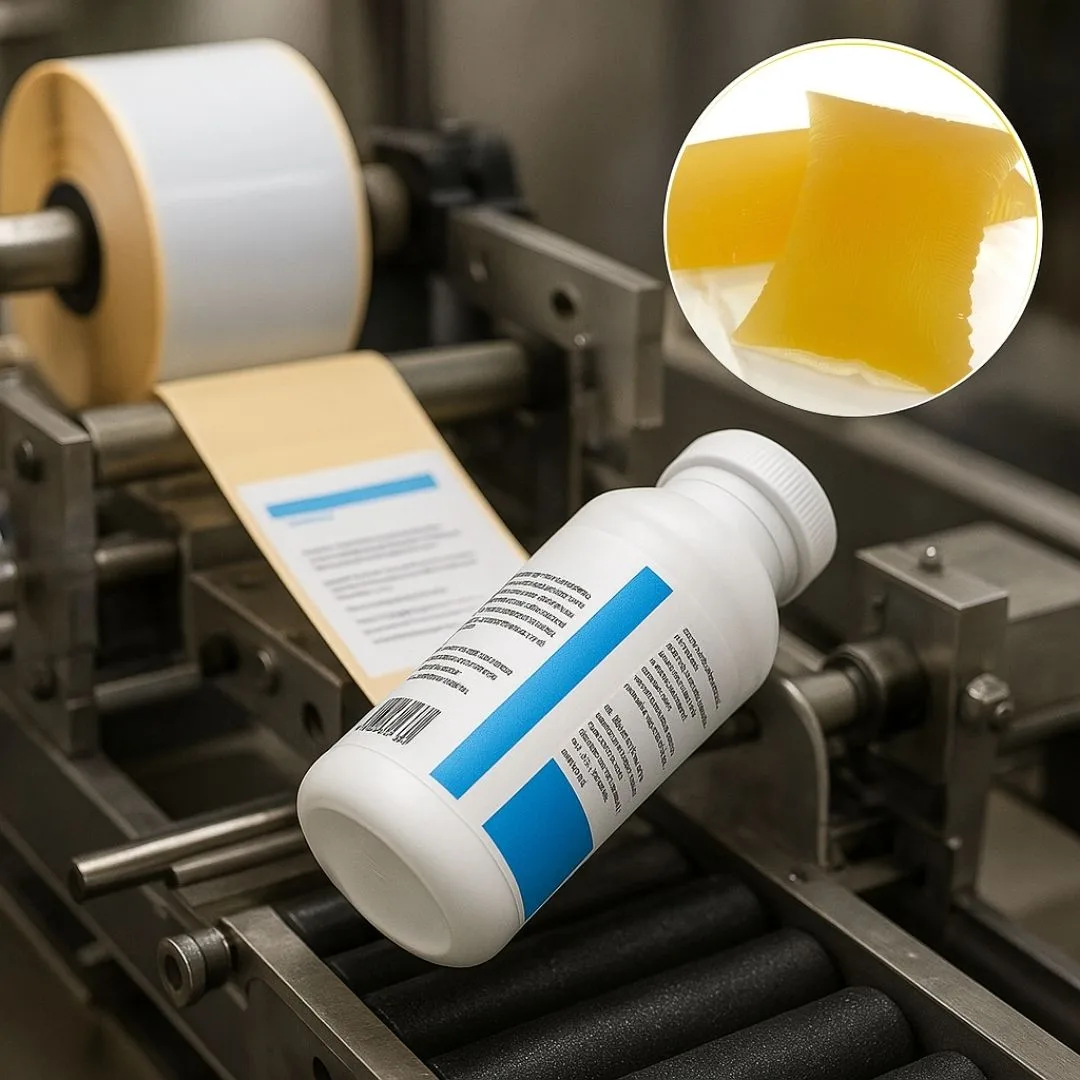
According to the published product information, the formulation supports automatic pump-type and pot-type labelling machines, along with semi-automatic and manual gumming systems. That range of compatibility can be valuable for manufacturers operating multiple production formats.
The adhesive is also described as providing high coverage and a colourless coating, which helps prevent the adhesive from affecting label appearance. Adchem states that its skid-free nature keeps labels in position immediately after application. The product is also promoted for humidity resistance and use in cold-chain storage and distribution conditions.
For businesses selecting a PET bottle labeling adhesive manufacturer, these specifications provide a practical checklist: substrate suitability, machine compatibility, coverage, tack, appearance and environmental resistance.
Important Features to Look For
A reliable PET bottle adhesive should support both product appearance and production consistency. The following features deserve close attention before a commercial purchase.
- ✓Strong and consistent adhesion on PET
- ✓High adhesive coverage
- ✓Clean or colourless coating
- ✓Good initial tack
- ✓Skid-free label positioning
- ✓Resistance to humidity
- ✓Reduced risk of wrinkles and air bubbles
- ✓Compatibility with the available labelling machine
- ✓Stable performance across production batches
- ✓Suitable shelf life for planned storage
- ✓Controlled adhesive consumption
- ✓Technical support for application trials
Adchem’s published CL & ADP information includes several of these characteristics, including high coverage, colourless coating, skid-free application, humidity resistance, good tack and resistance to bubble and wrinkle formation.
A specification sheet can identify technical properties, but a production trial should still confirm performance on the actual PET bottle and label construction.
Machine Compatibility Matters
A high-quality adhesive can still create production problems when its formulation does not suit the application system. Bottle labelling machines differ in adhesive transfer method, speed, roller configuration, pot design, pump operation and application quantity.
The CL & ADP Series is listed by Adchem for automatic pump-type and pot-type machines as well as semi-automatic and manual gumming systems.
The wider Adchem range follows the same application-specific principle. The AR & ADG Series is listed for automatic, semi-automatic, pump-type and pot-type systems and is designed for glass and PET bottles.
Before purchasing an adhesive, production teams should record machine speed, adhesive application method, roller settings, label format and bottle dimensions. A supplier can then assess whether the formulation is appropriate.
This approach can reduce trial-and-error and helps manufacturers choose a system that supports stable production rather than creating avoidable machine adjustments.
Humidity and Cold-Chain Performance
PET packaging frequently moves through warehouses, refrigerated transport and chilled retail environments. Moisture can collect on the bottle surface, particularly when a cold container enters warmer air. That condensation can challenge the adhesive bond.
A suitable formulation should maintain label positioning under the conditions expected during the product lifecycle. Adchem states that the CL & ADP Series provides humidity-resistant performance and is intended to remain reliable during cold storage and distribution.
This does not mean every PET bottle application has identical moisture requirements. Carbonated drinks, water bottles, spirits and pharmaceutical packaging may face different storage profiles. Manufacturers should test the adhesive under realistic conditions rather than relying solely on room-temperature checks.
For a PET bottle labeling adhesive manufacturer, environmental performance is therefore an important indicator of formulation quality. The adhesive should be selected according to the actual temperature, humidity and handling conditions rather than a generic specification.
Label Appearance and Shelf Presentation
A label does more than carry information. It represents the brand on a crowded retail shelf. Wrinkles, adhesive marks, air bubbles and label movement can make a premium product appear poorly finished.
Adchem’s AR & ADG Series is specifically promoted for glass and PET bottles where appearance is important. The company describes it as a transparent adhesive with a colourless coating and reports that its formulation is designed to prevent visible adhesive residue, wrinkles and air bubbles.
The CL & ADP Series follows a similar presentation objective for PET packaging. Its published features include a colourless coating, high coverage, good tack and reduced bubble and wrinkle formation.
A clean label result can improve product consistency across large production batches. It also makes quality control easier because packaging teams can identify defects quickly.
For premium beverages, pharmaceutical bottles and branded food products, visual uniformity is not an optional extra. It forms part of the finished product experience.
PET Bottle Adhesive for Different Industries
PET containers appear across several sectors, and each sector can impose different adhesive requirements. Beverage manufacturers may need resistance to chilled storage and condensation. Pharmaceutical companies may require a clean appearance and dependable label retention throughout distribution. Distilleries and wineries may prioritise presentation alongside adhesive performance.
Adchem’s CL & ADP Series is specifically listed for distilleries, wineries, food and beverage companies and pharmaceutical manufacturers.
The wider product portfolio extends beyond PET. Adchem’s IWR Series focuses on brewery labelling, while its SG-IWR Acrylic Adhesive is positioned for PET bottles, beer bottles and TIN containers. The PSA Series addresses pressure-sensitive applications for BOPP tapes and self-adhesive labels.
This broader portfolio is useful for manufacturers that package different container types because adhesive requirements can vary significantly between substrates.
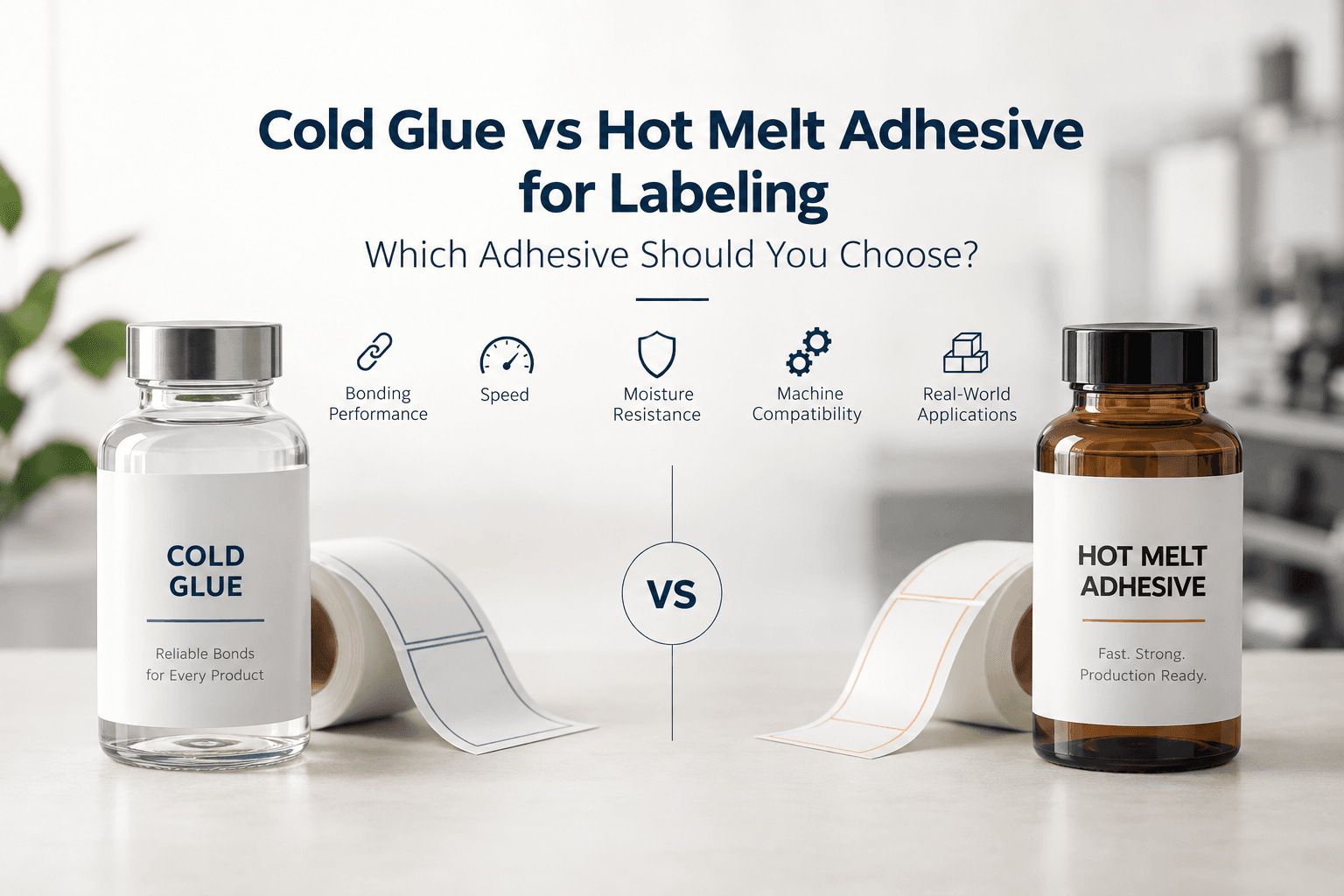
Cold Glue for PET Bottle Labelling
Cold-glue labelling remains an important option for PET bottle production. The adhesive is applied without the heating stage associated with hot melt technology, which can make it suitable for established water-based labelling equipment.
Adchem explicitly lists the CL & ADP Series as a cold glue solution for PET bottle labelling. The product is positioned for automatic, semi-automatic and manual gumming systems and is described as offering high coverage, colourless coating, humidity resistance and skid-free application.
The choice of cold glue should still reflect the actual packaging conditions. Label stock, bottle shape, machine speed and environmental exposure all influence performance.
The PET bottle labeling adhesive manufacturer should be able to provide technical guidance on application quantity, equipment compatibility and testing conditions. These details often make the difference between a formulation that works in theory and one that performs consistently in commercial production.
Hot Melt Adhesive as an Alternative
Hot melt adhesives use heat to convert the adhesive into a fluid state before application. The material then cools and forms a bond. This technology can be useful in production environments that place a high priority on rapid bond formation and high-speed automation.
Henkel currently lists both water-based and hot melt technologies for beverage and container labelling. Its portfolio addresses glass, plastic and aluminium applications and includes solutions designed for cold, wet and high-condensation environments.
H.B. Fuller also lists hot melt products for beverage labelling on PET, glass and metal containers. Its Clarity PHL 4150 and PHL 4170 products are specified for roller, nozzle or swirl application, with published application temperatures of 130°C to 160°C for those grades.
Hot melt can therefore be a strong technical option, but it requires heated application equipment and careful thermal control.
PET Bottle Labelling Adhesive Comparison
Choosing between water-based cold glue and hot melt becomes easier when manufacturers compare the technologies against the actual production line.
| Factor | Cold Glue for PET | Hot Melt for PET |
|---|---|---|
| Application | Applied without melting | Applied in a heated state |
| Bond formation | Develops as the water-based adhesive sets | Forms rapidly as the adhesive cools |
| Equipment | Pump, roller, pot or related system | Heated tank, hose, roller or nozzle system |
| PET compatibility | Specialised PET grades available | Specialised PET grades available |
| Humidity performance | Depends on formulation | Depends on formulation |
| High-speed production | Suitable formulations available | Often selected for rapid bond formation |
| Energy requirement | No melting stage | Heating required |
| Temperature control | Lower thermal requirement | Critical to viscosity and application |
| Maintenance | Focus on adhesive flow and clean equipment | Focus on heating, viscosity and char control |
| Best selection method | Test with actual bottle and label | Test with actual bottle and equipment |
Current industry portfolios show that both technologies can serve plastic container labelling, so the decision should be based on performance requirements rather than a universal preference.
How to Select the Right Manufacturer
Choosing a PET bottle labeling adhesive manufacturer should involve more than checking a product catalogue. Manufacturers should assess technical capability, formulation range, production capacity, testing facilities, application support and product consistency.
Adchem Industries states that it was established in 1984 and operates from West Bengal. Its infrastructure covers 1 acre, with a stated production capacity of 4 tonnes per day. The company also says that products are tested in a modern laboratory and that it maintains a separate R&D unit for formulation development.
A useful supplier evaluation should include:
- ✓1. Product suitability for PET.
- ✓2. Compatibility with your labelling machine.
- ✓3. Performance at your production speed.
- ✓4. Humidity and cold-storage performance.
- ✓5. Label appearance after application.
- ✓6. Technical data and sample availability.
- ✓7. Batch-to-batch consistency.
- ✓8. Commercial supply capability.
- ✓9. Application and troubleshooting support.
- ✓10. Total cost per labelled bottle.
This process helps buyers move from a price-led decision to a performance-led decision.
Quality Control Before Full-Scale Production
A production trial should evaluate the adhesive on the actual PET container, actual label stock and actual machine. Laboratory data is valuable, but the production environment reveals interactions that standard testing may not capture.
Inspect label position immediately after application. Then check adhesion after controlled exposure to humidity, refrigeration and normal handling. Look for wrinkles, bubbles, edge lifting, adhesive bleed and surface marks.
Machine behaviour should also be measured. Check whether the adhesive transfers uniformly, whether the machine requires frequent cleaning and whether application remains stable over an extended run.
Adchem states that it tests its manufactured products in a modern laboratory and maintains a separate R&D unit. Its product pages also provide application-specific information for different bottle substrates and machinery.
For buyers assessing a PET bottle labeling adhesive manufacturer, this combination of product testing and application support is useful because adhesive performance depends on both formulation and process conditions.
Why Adchem Industries Is Relevant for PET Packaging
Adchem Industries has structured its labelling portfolio around different packaging surfaces instead of presenting one adhesive as a universal solution. Its current product range includes the AR & ADG Series for glass and PET bottles, the IWR Series for breweries, CL & ADP for PET bottles, SG-IWR for PET, beer bottles and TIN containers, and PSA products for BOPP tape and self-adhesive labels.
The company also states that it serves markets across India and a wider international network that includes Bangladesh, Nepal, Bhutan, Sri Lanka, Africa, Brazil, Myanmar, Vietnam, Taiwan and Japan.
Its website currently identifies more than 42 years of experience and more than 500 clients worldwide. The company also lists customers and industries including breweries, distilleries, pharmaceutical companies, cosmetic brands and Ayurveda manufacturers. These are company-reported figures and associations, so buyers should verify any specific commercial reference directly with Adchem before making a purchasing decision.
Practical Checklist for PET Bottle Label Adhesive Buyers
Before placing a large adhesive order, packaging teams can use a simple checklist.
- ✓Identify the PET grade and bottle surface.
- ✓Confirm the label paper or film specification.
- ✓Record the production-line speed.
- ✓Identify the application equipment.
- ✓Define the required adhesive coverage.
- ✓Test initial tack and label positioning.
- ✓Test humidity resistance.
- ✓Test chilled or cold-chain exposure.
- ✓Inspect wrinkles and air bubbles.
- ✓Check adhesive residue and appearance.
- ✓Measure adhesive consumption.
- ✓Review shelf life and storage requirements.
- ✓Compare technical support from suppliers.
- ✓Approve the formulation only after a production trial.
This process gives the quality, production and procurement teams a common framework. It also reduces the risk of selecting an adhesive only because of a low purchase price.
Final Words
The search for a dependable PET bottle labeling adhesive manufacturer begins with one basic fact: PET packaging needs an adhesive that matches the surface, label and production environment. PET bottles may look simple, but their flexible structure, smooth surface and exposure to humidity or cold conditions can create demanding bonding requirements. A suitable formulation should therefore provide reliable tack, controlled coverage, stable label positioning and a clean finished appearance. It should also work smoothly with the machinery already installed on the production line.
Adchem Industries’ current portfolio reflects this application-driven model. Its CL & ADP Series is specifically presented as a labelling adhesive for PET bottles and is formulated using modified natural polymer technology. The company states that the product provides high coverage, a colourless coating, skid-free application, good tack, humidity resistance and compatibility with automatic, semi-automatic, pump-type and pot-type labelling systems. These properties align with several practical requirements faced by PET bottle manufacturers.
The wider Adchem portfolio can also support businesses that work with different packaging formats. AR & ADG is positioned for glass and PET bottles with a transparent finish, while SG-IWR is designed for PET, beer bottles and TIN containers with modified acrylic polymer technology and ice-water-resistant properties. The IWR Series is targeted at brewery applications and is described by Adchem as suitable for high-speed labelling machines, with published claims around ice-water resistance and easy bottle-washer removal.
Technology choice should still remain application-led. Water-based cold glue and hot melt adhesives can both serve PET packaging, but they work through different application processes. Henkel currently presents both water-based and hot melt labelling solutions for glass, plastic and aluminium packaging, while H.B. Fuller publishes hot melt beverage labelling products for PET, glass and metal containers. Selected H.B. Fuller grades are documented for roller, nozzle or swirl systems at 130°C to 160°C.
For this reason, manufacturers should avoid choosing an adhesive solely because it is marketed as stronger, faster or more economical. The correct formulation is the one that meets the measurable demands of the specific packaging process. A production team should assess initial tack, label alignment, coverage, appearance, moisture resistance, cold-chain behaviour, machine compatibility, adhesive consumption and long-term bond retention. These tests provide a much clearer basis for procurement than a generic comparison between adhesive types.
The manufacturer’s technical capability also matters. Adchem Industries states that it has operated since 1984, maintains a 1-acre manufacturing infrastructure with a stated production capacity of 4 tonnes per day, and uses a modern laboratory with a separate R&D unit for product development. A supplier with formulation knowledge and application support can help identify the correct product grade, optimise the process and troubleshoot performance issues when packaging conditions change.
For companies evaluating a PET bottle labeling adhesive manufacturer, the smartest purchasing process is therefore straightforward: define the application, test suitable formulations on the actual packaging line, measure the results and then scale the approved product. This method can reduce waste, limit production interruptions and improve finished-product consistency.
A well-selected adhesive should remain almost invisible in the final packaging. The label should sit firmly, look clean and remain stable through handling, storage and transport. When the adhesive performs quietly and consistently, the manufacturer gains more than a secure label. The business gains production reliability, better visual quality and greater confidence in every packaged unit leaving the factory.
Ready to Upgrade Your Label Adhesive System?
Get a free Adhesive consultation and sample kit tailored to your production line.