Cold Glue vs Hot Melt Adhesive for Labeling: Which Adhesive Should You Choose?
Introduction
A label is often the first visual element a customer notices on a bottle, jar, can or packaged product. A neat, wrinkle-free label can strengthen brand presentation, while poor adhesion can create peeling edges, bubbles, misalignment and visible adhesive marks. For manufacturers, these defects can also increase product waste, machine interruptions and rework. The adhesive therefore plays a much bigger role than its small quantity on the production line suggests.
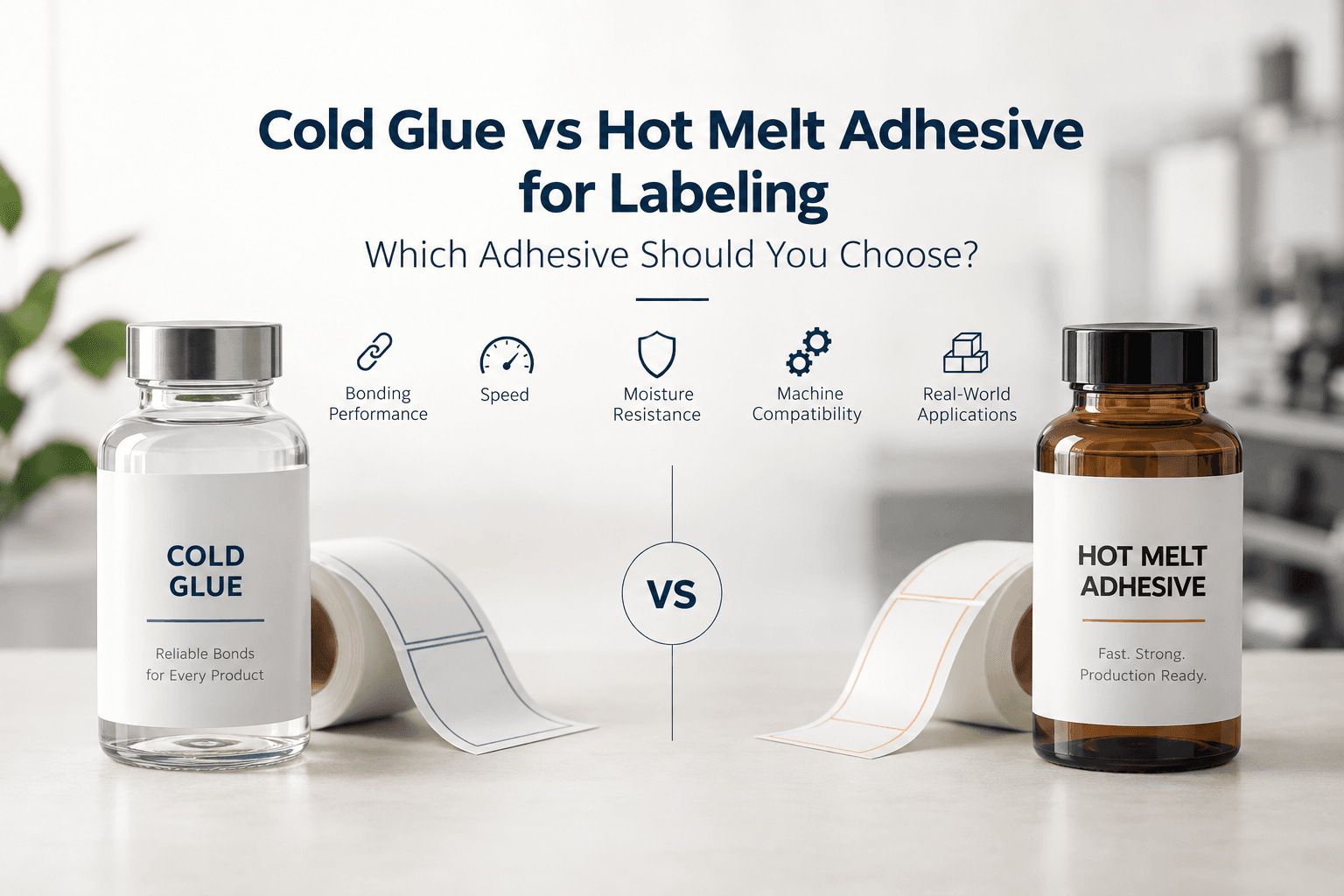
The choice between Cold glue vs hot melt adhesive for labeling depends on the packaging substrate, label material, machine speed, temperature, humidity and final-use conditions. Cold glue usually refers to water-based adhesive technology applied without melting, while hot melt adhesive is heated before application and forms a bond as it cools. Each technology has different operating characteristics, and selecting the right option requires more than comparing adhesive price alone.
Adchem Industries has built its labelling adhesive portfolio around specific packaging requirements. The company was established in 1984 and currently states that it has more than 42 years of industry experience, more than 500 clients worldwide, laboratory testing facilities and a dedicated R&D unit. Its portfolio includes AR & ADG, IWR, CL & ADP, SG-IWR and PSA adhesive solutions for glass, PET, brewery, beer bottle, TIN, BOPP and self-adhesive labelling applications.
What Is Cold Glue for Labelling?
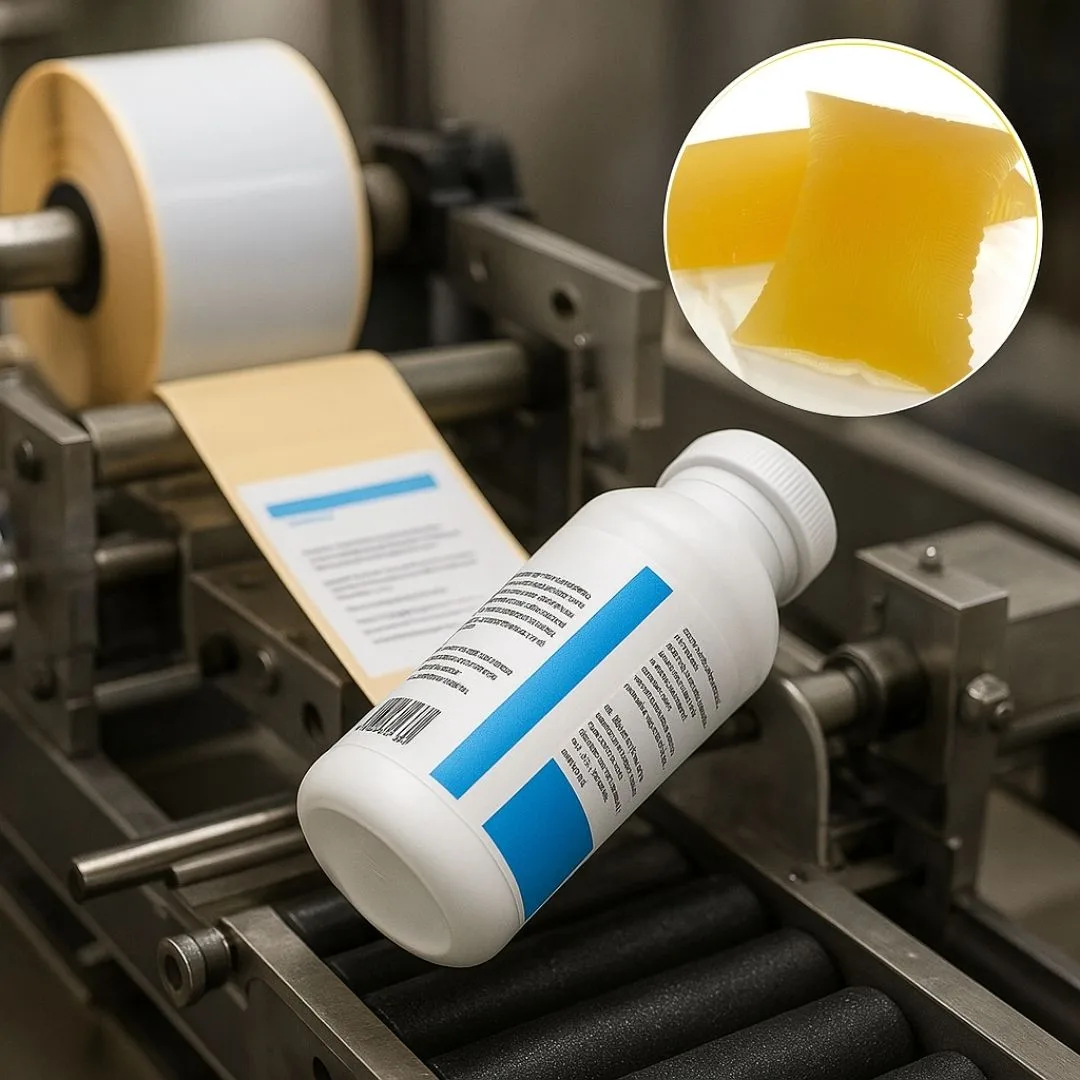
Cold glue is generally a water-based adhesive that is applied at normal processing temperatures rather than being melted before application. In bottle labelling, the adhesive is transferred through systems such as rollers, pumps or pots before the label is positioned onto the container.
Cold-glue technology can be particularly valuable for glass and PET packaging where manufacturers need consistent coverage and controlled application. Its performance can also be tailored for environments involving refrigeration, humidity and condensation. Henkel lists water-based labelling adhesives as suitable for glass, plastic and aluminium packaging, with solutions designed around application quality, durability and production efficiency.
Adchem Industries offers several cold-glue labelling solutions. The IWR Series is positioned as an ice-water-resistant adhesive for breweries, while the CL & ADP Series is formulated for PET bottles. The AR & ADG Series provides transparent labelling adhesion for glass and PET bottles.
What Is Hot Melt Adhesive?
Hot melt adhesive is a thermoplastic material that becomes fluid when heated and forms a bond as it cools. Unlike conventional water-based systems, the adhesive does not depend on water evaporation to establish the final bond. This characteristic can support rapid packaging operations where labels must be applied and secured within a short production cycle.
Hot melt technology is widely used in industrial packaging and container labelling. Henkel lists hot melt solutions for glass, plastic and metal packaging, while H.B. Fuller provides beverage labelling grades for glass, PET and metal containers and documents application temperatures in the range of 130°C to 160°C for selected products.
For manufacturers, the attraction of hot melt often comes from fast bond formation and compatibility with highly automated production. However, the system requires heated equipment, temperature control and appropriate maintenance. Adhesive selection must therefore consider not only bond performance but also the complete application system.
Cold Glue vs Hot Melt Adhesive for Labeling: Core Comparison
The most useful way to evaluate Cold glue vs hot melt adhesive for labeling is to compare how each system behaves on the production line.
| Factor | Cold Glue | Hot Melt Adhesive |
|---|---|---|
| Application temperature | Normal processing temperature | Heated before application |
| Bond formation | Develops through water-based adhesive setting | Forms rapidly as adhesive cools |
| Equipment | Roller, pump, pot or similar systems | Heated tank, hose, roller or nozzle systems |
| Production speed | Suitable for many high-speed labelling systems | Particularly suitable for very high-speed lines |
| Glass labelling | Strong application potential | Available for glass applications |
| PET labelling | Specialised grades available | Suitable grades available |
| Moisture performance | Specific grades can offer high moisture resistance | Depends on formulation |
| Ice-water exposure | IWR cold-glue grades are available | Selected hot melts can handle cold and wet containers |
| Maintenance | Focus on adhesive flow and equipment cleanliness | Requires temperature and char control |
| Energy requirement | No melting stage | Requires heating |
| Typical strength | Depends on formulation and substrate | Depends on formulation and application temperature |
The table shows that neither technology is automatically suitable for every packaging line. The substrate and production environment should determine the final selection.
Where Cold Glue Performs Particularly Well
Cold glue can be highly effective when the packaging process requires controlled adhesive application and reliable label positioning. Glass bottles remain an important application because glass provides a stable surface for many conventional labelling systems. PET bottles require more specialised formulations because the substrate is lighter and can flex during handling.
Adchem’s AR & ADG Series is formulated with modified natural polymers and is described as a transparent labelling adhesive for glass and PET bottles. The product is designed for automatic, semi-automatic, pump-type and pot-type labelling systems. Adchem also specifies high coverage, colourless coating, high tack, humidity resistance and resistance to air bubbles and wrinkles for this series.
The IWR Series addresses an even more demanding environment. Adchem states that the product is designed for brewery labelling and can provide ice-water-resistant performance on metallised labels after curing. The company specifies performance across 3 to 7 days of ice-water exposure.
Where Hot Melt Has a Strong Advantage
Hot melt adhesive becomes particularly attractive when the packaging operation places a high value on rapid bond formation. Because the adhesive solidifies through cooling, production lines can achieve quick handling after application. This can support fast packaging cycles and continuous automation.
H.B. Fuller’s beverage labelling portfolio includes hot melt products for glass, PET and metal containers. Its published technical information lists selected grades for magazine-fed and roll-fed labels, with options for roller, nozzle and swirl application. The documented application temperature for the cited Clarity products is 130°C to 160°C.
Henkel also identifies hot melt technology for beverage and container labelling and notes that its TECHNOMELT range addresses plastic and aluminium packaging as part of its labelling portfolio.
The main operational consideration is equipment. Hot melt requires controlled heating from the melting stage through delivery and application. Poor temperature control can affect viscosity, adhesive transfer and equipment cleanliness. For this reason, line design and maintenance form an important part of hot melt performance.
Choosing the Right Adhesive for Glass Bottles
Glass bottle labelling requires a combination of adhesion, appearance and process consistency. A premium spirits bottle, wine bottle or pharmaceutical container needs a label that sits cleanly and remains firmly attached during transportation and storage.
The AR & ADG Series from Adchem Industries is designed specifically for glass and PET packaging. The company describes it as transparent and colourless, with high tack, high coverage and humidity-resistant properties. It is also designed to reduce visible residue, wrinkles and air bubbles.
For manufacturers handling chilled beverages, moisture conditions become especially important. Glass bottles can collect condensation when moved between cold storage and ambient conditions. A suitable adhesive must maintain adequate bond strength under these conditions.
This is where application testing becomes valuable. Manufacturers should assess the actual bottle finish, label paper, application temperature, adhesive quantity and storage environment before changing adhesive systems. A formulation that performs well on one glass surface may require adjustment on another.
Choosing the Right Adhesive for PET Bottles
PET bottles create different bonding conditions because the material is lightweight, flexible and widely used in high-volume beverage packaging. A label adhesive must maintain a secure bond while tolerating handling, humidity, cold storage and transportation.
Adchem Industries developed its CL & ADP Series for PET bottle labelling. The company describes the product as a modified natural polymer-based adhesive suitable for automatic, semi-automatic and manual gumming applications. The product information highlights high coverage, colourless coating, skid-free application, humidity resistance, good tack and resistance to air bubbles and wrinkles.
Adchem also offers the SG-IWR Acrylic Adhesive for PET bottles, beer bottles and TIN containers. This synthetic adhesive uses modified acrylic polymer technology and is positioned for surfaces where stronger chemical versatility and sustained adhesion are required.
When comparing Cold glue vs hot melt adhesive for labeling on PET, manufacturers should consider bottle flexibility, label stock, machine speed and the temperature profile of the packaging line.
Brewery and Beer Bottle Labelling
Brewery packaging creates an unusually demanding adhesive environment. Beer bottles may pass through filling, labelling, refrigeration, transportation, ice buckets and retail coolers. Condensation and ice water can place considerable stress on label adhesion.
Adchem’s IWR Series is specifically positioned for brewery applications and is compatible with high-speed labelling machines, including KHS and Krones systems according to the company’s published product information. Adchem states that its IWR formulation develops the specified ice-water-resistant properties on metallised labels after 48 hours of curing and can maintain adhesion during 3 to 7 days of ice-water exposure.
The company’s product portfolio also identifies IWR as a cold adhesive for breweries and beer bottles.
For a brewery, adhesive choice should therefore include cold-storage conditions and not just initial tack. A label that performs well immediately after application may still fail later when the bottle becomes wet and cold. This makes moisture resistance, curing behaviour, application consistency and wash-off requirements important evaluation criteria.
Performance Factors Manufacturers Should Measure
Choosing between adhesive technologies becomes easier when manufacturers define measurable production requirements. The following factors can provide a practical testing framework.
- ✓Initial tack: Measures how quickly the label holds after application.
- ✓Final bond strength: Indicates how well the label remains attached during handling.
- ✓Moisture resistance: Important for chilled products, refrigerated storage and humid warehouses.
- ✓Ice-water resistance: Essential for beer bottles and other cold beverage applications.
- ✓Coverage: Shows how efficiently the adhesive spreads across the label area.
- ✓Machine compatibility: Confirms that the formulation performs correctly with the available equipment.
- ✓Appearance: Checks for residue, wrinkles, bubbles, colour and edge lifting.
- ✓Shelf life: Indicates whether the adhesive can remain stable during storage.
- ✓Consumption: Helps calculate the adhesive cost per labelled container.
- ✓Cleaning requirements: Shows how easily adhesive buildup can be controlled on production equipment.
These measurements create a more reliable basis for adhesive selection than purchase price alone. Product material supplied for Adchem Industries also highlights strong bonding, water and moisture resistance, high-speed machine compatibility, premium quality and consistent performance as key solution attributes.
Adchem Industries Labelling Adhesive Portfolio
Adchem Industries maintains a specialised labelling adhesive range covering multiple packaging substrates and applications.
| Adchem Series | Primary Application | Notable Characteristics |
|---|---|---|
| AR & ADG | Glass and PET bottles | Transparent coating, high tack, humidity resistance |
| IWR | Breweries and beer bottles | Ice-water-resistant labelling performance |
| CL & ADP | PET bottles | High coverage, skid-free application, humidity resistance |
| SG-IWR | Beer bottles, PET and TIN containers | Modified acrylic polymer technology, IWR properties |
| PSA | Self-adhesive labels and BOPP tapes | Pressure-sensitive bonding, tack, clarity and coverage |
Adchem’s official product catalogue identifies these five product families as its principal labelling adhesive solutions. The range demonstrates an application-led approach. Instead of treating all packaging surfaces in the same way, manufacturers can evaluate a formulation according to bottle material, label construction, operating environment and machine configuration.
Why Adhesive Quality Affects Production Efficiency
An adhesive does more than hold a label against a container. Its behaviour can influence machine performance, product appearance, waste levels and production continuity.
Poor adhesive transfer may create incomplete coverage, while excessive adhesive can increase consumption and create machine contamination. Inconsistent tack can lead to label movement before the bond develops. Wrinkles or air bubbles can create reject products even when the label technically remains attached.
Adchem’s AR & ADG and CL & ADP product information specifically highlights high coverage and reduced problems such as bubbles and wrinkles. The PSA Series is designed for pressure-sensitive applications where self-adhesive labels need strong tack, clean appearance and resistance to edge lifting.
For a manufacturing business, these details matter because every packaging defect has a cost. Adhesive consumption, labour, rejected containers, cleaning time and production downtime all contribute to the total operating cost. A suitable formulation can therefore support both packaging quality and production efficiency.
Cold Glue vs Hot Melt Adhesive for Labeling: Cost Considerations
The purchase price of an adhesive does not show its complete economic impact. Manufacturers should calculate the total cost of the application system.
For cold glue, the evaluation should include adhesive consumption, application quantity, machine efficiency, cleaning requirements and the behaviour of labels during storage. For hot melt, the calculation should also account for heating equipment, energy use, maintenance, adhesive consumption and temperature control.
Hot melt can offer strong productivity benefits where rapid bond formation supports faster production. H.B. Fuller specifically positions selected hot melt beverage labelling products for high-speed lines, while Henkel describes hot melt solutions as part of its wider container labelling technology portfolio.
Cold glue can provide a practical route where manufacturers already operate compatible water-based labelling equipment and need specialised properties such as humidity or ice-water resistance. Adchem’s IWR, AR & ADG and CL & ADP ranges illustrate how such properties can be formulated for different packaging requirements.
The correct comparison is therefore total cost per successful labelled container, not price per kilogram.
How to Select the Right Labelling Adhesive
A structured selection process can reduce trial-and-error and improve production reliability. Start by identifying the substrate. Decide whether the container is glass, PET, metal or another material. Next, define the label stock because paper, metallised labels, synthetic films and BOPP can require different adhesive characteristics.
Then review machine conditions. Record line speed, application method, adhesive temperature, roller settings and adhesive quantity. Environmental conditions also matter. Note whether containers are cold, wet, refrigerated or exposed to condensation.
Finally, conduct a controlled production trial. Examine initial tack, label position, bond development, moisture resistance, visual finish and long-term adhesion.
The most useful questions include:
- ✓Does the label remain in the correct position?
- ✓Does the adhesive create bubbles or wrinkles?
- ✓Can the line run continuously without excess buildup?
- ✓Does the bond withstand humidity or ice water?
- ✓Does the adhesive remain visually clean?
- ✓Is adhesive consumption within the planned range?
- ✓Does the formulation suit the existing machine?
This approach makes adhesive selection precise, measurable and commercially practical.
Final Words
The choice between Cold glue vs hot melt adhesive for labeling should begin with the application rather than the technology itself. A brewery labelling cold, wet beer bottles has different requirements from a pharmaceutical manufacturer labelling clean glass containers. A PET water bottle line may prioritise flexibility, humidity resistance and high-speed production, while a premium wine or spirits producer may place greater emphasis on a spotless finish, precise label positioning and long-term adhesion. These differences explain why adhesive manufacturers continue to develop specialised formulations for specific substrates and packaging environments.
Cold glue remains an important option for bottle labelling because water-based formulations can be engineered for strong adhesion, high coverage and resistance to challenging conditions. Adchem Industries’ portfolio demonstrates this application-specific strategy. The AR & ADG Series is positioned for transparent labelling on glass and PET bottles, with the company highlighting high tack, colourless coating, humidity resistance and clean application. The CL & ADP Series targets PET bottles and emphasises high coverage, skid-free application and reliable performance in humid and cold-chain conditions. The IWR Series focuses on breweries and beer bottles where ice-water resistance is a critical packaging requirement.
Hot melt, meanwhile, offers a different set of production characteristics. Its thermoplastic structure allows the adhesive to be heated, applied and rapidly solidified, making the technology relevant to high-speed automated packaging. Current industry information from Henkel and H.B. Fuller shows hot melt labelling systems being used across glass, PET and metal containers, with selected beverage grades developed for cold and wet packaging environments. H.B. Fuller documents application temperatures of 130°C to 160°C for selected beverage hot melts, demonstrating the importance of controlled thermal processing.
The final decision should therefore include substrate, label stock, production speed, machine configuration, temperature, moisture, storage conditions and total operating cost. A laboratory trial can establish technical suitability, but a controlled production trial provides the strongest evidence because it captures the interaction between adhesive, label, bottle and machine.
For manufacturers seeking a complete labelling solution, Adchem Industries provides a broad range of adhesive technologies rather than relying on one universal formulation. Its website identifies labelling adhesives for glass, PET, breweries, beer bottles, TIN containers, BOPP tapes and self-adhesive labels. The company also states that its products are tested in a modern laboratory and supported by a separate R&D unit.
That combination of product specialisation and technical evaluation can help businesses select an adhesive based on real production requirements. The objective is simple: secure labels, clean appearance, stable machine performance and fewer packaging defects. When the adhesive matches the substrate and operating environment correctly, it becomes a quiet but highly valuable component of the entire packaging process.
For buyers comparing Cold glue vs hot melt adhesive for labeling, the best starting point is a clear technical assessment of the production line. Test the adhesive on the actual container and label stock, measure the required performance conditions and select the formulation that supports dependable results. Adchem Industries can provide product-specific information, samples and technical support for manufacturers evaluating its labelling adhesive range.
In packaging, consistency matters. A label should remain straight, secure and visually clean from the moment it leaves the labelling machine until the finished product reaches the customer. The right adhesive helps make that result repeatable, which is why adhesive selection deserves the same attention as the bottle, label and machine itself.
Ready to Upgrade Your Label Adhesive System?
Get a free Adhesive consultation and sample kit tailored to your production line.