Wood Adhesive Manufacturer in India: Complete Guide to Reliable Wood Bonding
Introduction
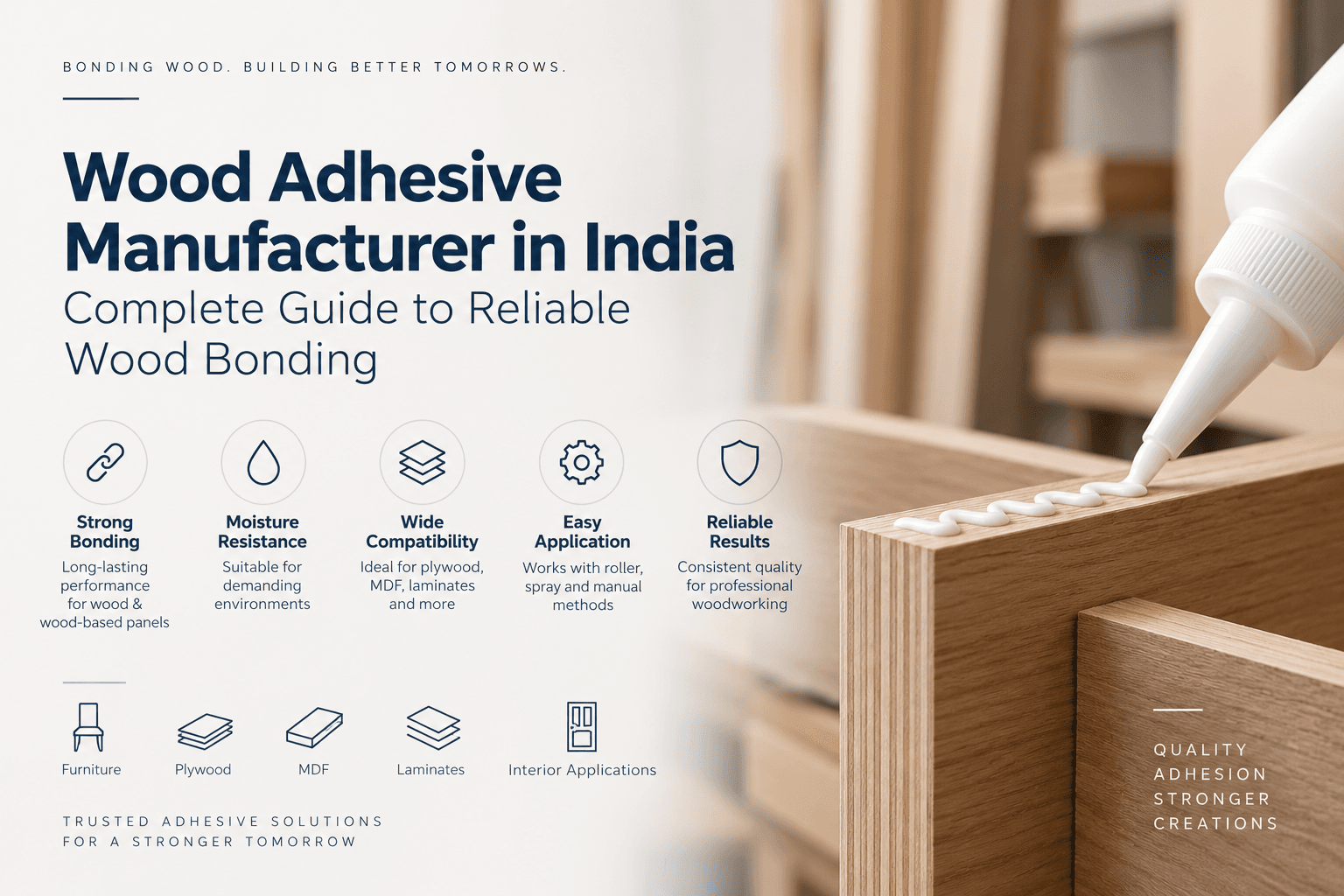
Wood bonding looks simple until the finished product begins to face real working conditions. Furniture joints must remain secure during daily use. Plywood panels need dependable adhesion through pressing, handling and machining. Laminates, veneers, MDF and other engineered boards also require an adhesive that spreads evenly, develops sufficient bond strength and supports a clean final finish. When the adhesive is poorly matched to the material or application method, manufacturers can face joint failure, excessive adhesive consumption, uneven surfaces and avoidable production delays.
Choosing a reliable Wood adhesive manufacturer in India therefore involves more than comparing product prices. The manufacturer should offer formulations that suit different wood substrates, production methods and environmental conditions. Factors such as spreadability, tack, setting behaviour, moisture resistance, viscosity and application equipment can directly influence the quality of the finished assembly. Modern woodworking also places greater emphasis on production efficiency, repeatability and controlled material usage.
Adchem Industries has a dedicated Wood Adhesives category and currently lists ADBOND MARINE D3 as a premium-grade pure PVA-based adhesive with waterproofing properties and low viscosity intended to support roller and sprayable application. The company was established in 1984 and states that it operates a one-acre facility with a production capacity of 4 tonnes per day, supported by a modern laboratory and separate R&D unit.
What Is Wood Adhesive?
Wood adhesive is a bonding material formulated to join wood and wood-based substrates. Depending on its chemistry, it can bond solid timber, plywood, veneers, MDF, particle board, laminates and other porous materials. The adhesive fills microscopic irregularities between mating surfaces and develops a bond that holds the components together after setting or curing.
PVA-based emulsions are common in woodworking because they offer practical application, straightforward handling and good coverage. Other technologies include synthetic resin, polyurethane and hot-melt systems, each designed for specific performance conditions. The correct formulation depends on the application. A cabinet assembly used indoors may not require the same moisture resistance as furniture intended for humid kitchens or commercial interiors.
Adchem describes its wood adhesive as offering excellent coverage, minimum bonding time and permanent bonding. Its current Wood Adhesives page also identifies ADBOND MARINE D3 as a low-viscosity PVA-based adhesive suitable for roller and sprayable applications.
Why Wood Adhesive Quality Matters
An adhesive joint becomes part of the structure of a wooden assembly. If the bond is inconsistent, the finished product can develop movement, separation or surface defects. A strong formulation alone does not solve every problem because successful bonding also depends on surface preparation, adhesive quantity, pressure and curing conditions.
Good wood adhesive can help manufacturers achieve more predictable results across repeated production batches. Consistent viscosity can support uniform spreading, while suitable wet tack can help components stay aligned before the final bond develops.
Water resistance is another important consideration. Moisture can affect wood dimensions and place stress on adhesive joints. A formulation intended for humid environments should therefore be selected with care rather than relying on a standard interior-grade product.
Commercial wood adhesives on the Indian market commonly target wood, plywood, laminates, veneers, particle board and MDF. For example, 3M India lists a water-based synthetic resin adhesive for these porous substrates and highlights initial tack, coverage, fungus resistance and resistance to hot and cold water.
ADBOND MARINE D3 from Adchem Industries
Adchem Industries' ADBOND MARINE D3 is the principal wood adhesive currently displayed on its dedicated Wood Adhesives page. The company describes it as a premium-grade, pure PVA-based adhesive with waterproofing properties. It also states that the product has low viscosity, which helps support roller and sprayable application.
This combination can be useful for woodworking operations where controlled application and broad surface coverage matter. Low viscosity can help an adhesive move smoothly through suitable application systems, although final machine settings must always be matched to the specific equipment and production conditions.
The word "Marine" also signals a performance-oriented positioning around moisture exposure. Manufacturers should still review the current technical datasheet before specifying the product for a particular outdoor, marine or high-humidity application.
For buyers evaluating a Wood adhesive manufacturer in India, product documentation matters as much as marketing language. Application range, viscosity, recommended spread rate, setting conditions, substrate compatibility and water-resistance performance should be verified before production approval.
Key Features to Evaluate in a Wood Adhesive
A useful wood adhesive specification should cover both bonding performance and production behaviour.
- ✓Bond strength on the intended substrates
- ✓Initial tack and component hold
- ✓Spreadability and coverage
- ✓Viscosity stability
- ✓Setting or curing behaviour
- ✓Moisture and water resistance
- ✓Heat resistance where required
- ✓Resistance to joint movement
- ✓Compatibility with rollers, brushes or spray systems
- ✓Clean application and suitable finish
- ✓Storage stability and shelf life
- ✓Batch-to-batch consistency
Adchem's website identifies excellent coverage, minimum bonding time and permanent bonding as advantages of its Wood Adhesives category.
Independent Indian adhesive suppliers also commonly highlight high tack, coverage, water resistance and suitability for porous materials as key requirements in woodworking adhesives. Astral's Bondtite Deluxe, for example, is described as a single-component PVA emulsion for wood, plywood, laminates, veneers, particle board, block board and MDF, with water and heat resistance.
Wood Adhesive for Plywood Manufacturing
Plywood production demands dependable bonding because several veneer layers must remain securely joined throughout pressing, conditioning and subsequent use. The adhesive must spread across the veneer surfaces and develop sufficient bond strength under the selected pressing conditions.
Plywood also has different performance grades, so the adhesive specification should align with the intended end use. Moisture resistance, cyclic exposure and bond durability can become important for products used in demanding environments.
The Bureau of Indian Standards currently lists IS 848 (2025), titled "Synthetic Resin Adhesives for Plywood (Phenolic, Aminoplastic and Bio-Materials Based) - Specification", with MR, BWR and BWP grades. The current BIS testing records show the 2025 revision in active use from 2025 and 2026 dates, replacing reliance on the older 2006 reference for current specifications.
This distinction matters for procurement teams. Buyers should identify the applicable plywood grade and check whether the selected adhesive and finished board meet the required standard through appropriate testing.
Wood Adhesive for Furniture Manufacturing
Furniture manufacturers need an adhesive that supports both strength and production speed. Cabinet components, carcasses, drawers, shelves, frames and decorative surfaces can involve different bonding geometries and different materials.
A good furniture adhesive should provide reliable wet tack so components remain aligned during assembly. It should also spread consistently across the substrate without creating excessive squeeze-out.
Moisture performance can become particularly important for kitchen furniture, bathroom furniture and other installations exposed to humidity. Current Indian woodworking products commonly provide standard, water-resistant and more specialised formulations for these environments. Astral, for example, markets its Bondtite Aqua PVA wood adhesive for furniture exposed to high humidity and moist areas, including kitchens and bathrooms.
The final selection should reflect the actual use environment, joining method and expected service conditions rather than simply the furniture category.
Bonding Wood, MDF, Particle Board and Laminates
Woodworking rarely involves solid timber alone. Modern furniture and interior products frequently combine plywood, MDF, particle board, veneers and decorative laminates.
These substrates have different surface properties and porosity. MDF and particle board can absorb adhesive differently from dense laminates. Veneer thickness can also influence how pressure and adhesive quantity affect the finished surface.
The adhesive must therefore provide sufficient wetting and coverage without excessive application. Too little adhesive can create incomplete contact, while too much can increase drying time and squeeze-out.
3M India's current Synthetic Resin Adhesive is one example of a water-based product positioned for wood, plywood, laminates, veneers, particle board and MDF, with one of the recommended use cases involving porous substrates.
For production environments that process multiple board types, application trials can help establish the correct adhesive quantity and pressing conditions for each substrate combination.
Viscosity and Spreadability in Woodworking
Viscosity directly affects how an adhesive moves through an application system and spreads over the joining surface. A formulation that is too thick may create uneven coverage or increase equipment load. A formulation that is too fluid may run excessively or provide inadequate control in some applications.
Adchem specifically highlights the low viscosity of ADBOND MARINE D3 and states that this supports roller and sprayable application.
Spreadability also affects adhesive consumption. When the formulation coats the surface uniformly, manufacturers can aim for the required coverage without unnecessarily heavy application.
Equipment type matters as well. A brush application, roller coater, automatic spreader and spray system may require different process settings. Manufacturers should therefore evaluate viscosity together with shear behaviour, application temperature and equipment design. A supplier that can provide technical guidance on these parameters can help reduce initial setup time and make production more consistent.
Cold Press and Other Application Methods
Cold pressing remains a practical method for many woodworking applications because it avoids the additional equipment associated with hot pressing. However, the adhesive must be selected according to the available pressure, clamping period and production schedule.
Some adhesives require longer time before the joint can be machined or moved. Others are formulated to provide faster handling, helping manufacturers increase throughput.
Adhesive suppliers in India commonly present products for manual application, roller spreading and automated processing. Tekbond, for example, lists a separate hot-melt edgebanding adhesive for furniture, modular kitchens and cupboards, with applications including PVC and ABS edge bands, plywood, MDF and particle board.
The application process should therefore be treated as part of adhesive selection. The correct product must fit the machine, substrate and production cycle.
Moisture Resistance and Humid Conditions
Moisture is one of the most persistent threats to wooden joints. Wood can absorb water vapour and liquid moisture, causing dimensional changes. The resulting stress can challenge a bond over time.
For indoor furniture installed in relatively dry rooms, standard woodworking grades may be sufficient. Kitchens, bathrooms, utility areas and selected commercial environments can require stronger moisture resistance.
Adchem positions ADBOND MARINE D3 as a PVA-based adhesive with waterproofing properties.
Other Indian wood adhesive products also use D3 or similar water-resistance classifications for furniture exposed to moisture. Glutinous Industries, for example, describes its D3 PVA adhesive as intended for wood, plywood, veneers, MDF and similar substrates and states that full water resistance develops after curing.
The specific water-resistance level should always be matched to the intended application and verified through the relevant testing standard.
Wood Adhesive Selection by Application
Selecting a Wood adhesive manufacturer in India becomes easier when the end use is defined first.
| Application | Typical Substrates | Important Adhesive Requirements |
|---|---|---|
| Furniture assembly | Wood, plywood, MDF, particle board | Tack, spreadability, bond strength |
| Plywood | Veneer layers | Bond durability, pressing performance |
| Laminate bonding | Plywood, MDF, particle board, laminate | Adhesion, surface wetting, clean finish |
| Veneer bonding | Veneer, plywood, MDF | Even spread, low defects |
| Cabinet manufacturing | MDF, plywood, particle board | Fast handling, machine compatibility |
| Kitchen furniture | Wood-based boards, laminates | Moisture resistance, durable bonding |
| Bathroom furniture | MDF, plywood, laminates | Enhanced moisture resistance |
| Decorative woodwork | Timber, veneer, boards | Clean finish and reliable adhesion |
| Spray or roller application | Multiple wood substrates | Controlled viscosity and uniform transfer |
The table is a starting point rather than a substitute for technical testing. Substrate density, surface preparation and production conditions can change adhesive performance significantly.
Surface Preparation Before Applying Wood Adhesive
Even a high-performance adhesive can fail when the substrate is poorly prepared. Dust, grease, loose fibres and uneven machining can reduce surface contact and weaken the joint. Wood surfaces should be clean and sufficiently dry for the selected adhesive system. The mating surfaces should fit accurately because excessive gaps place greater demand on the adhesive layer.
Application quantity also matters. Manufacturers should avoid assuming that more adhesive means a stronger joint. Excess product can increase drying time, create squeeze-out and raise material costs without improving the bond proportionally.
Pressure should create intimate contact between the two surfaces. The exact pressure, clamping duration and curing conditions should follow the adhesive supplier's technical instructions. A controlled preparation routine creates a more stable process and makes quality issues easier to diagnose.
Testing Wood Adhesive Before Production Approval
Product approval should include practical testing on the actual materials and application system. A laboratory test can provide useful information, but production trials reveal how the adhesive behaves under real operating conditions.
Manufacturers should evaluate wet tack, spreading behaviour, open time, clamping requirements and final bond strength. Water exposure should also be tested when the finished product may encounter humidity or liquid moisture.
The substrate combination matters. Test wood-to-wood joints separately from laminate-to-MDF or veneer-to-plywood joints because absorption and surface energy can differ.
BIS documentation for plywood adhesives includes tests relating to setting times, pH and cyclic moisture performance for applicable grades under IS 848. A structured trial helps procurement and production teams establish a measurable performance baseline before a full-scale adhesive change.
Choosing a Wood Adhesive Manufacturer in India
A dependable Wood adhesive manufacturer in India should combine product formulation with manufacturing capability and technical support. Procurement teams should examine the manufacturer's history, testing infrastructure, production capacity, application knowledge and ability to maintain consistent supply.
Adchem Industries states that it was established in 1984 and operates a one-acre manufacturing facility with technologically advanced machinery and a stated production capacity of 4 tonnes per day. The company also says that manufactured products are checked in a modern laboratory and that it maintains a separate R&D unit for formulation development.
Its current website presents Wood Adhesives alongside Labelling Adhesives and Metal Pretreatment Chemicals as part of its wider industrial portfolio. These capabilities can matter when a buyer needs more than a standard product. Technical formulation support can help manufacturers address changes in substrate, machinery, humidity or production throughput.
Quality Control and Batch Consistency
Wood adhesive performance must remain consistent from one production batch to another. Variations in viscosity, solids content or other formulation parameters can affect spreading, drying and bond formation.
A robust quality-control programme should therefore include routine testing before material reaches the production floor. The exact tests depend on the formulation and intended application, but manufacturers commonly monitor physical properties and bonding performance.
Adchem states that all its manufactured products are checked and tested in its modern laboratory and that its separate R&D unit develops formulations for its product range.
For customers, consistency reduces the need to repeatedly adjust equipment settings. It also makes production planning more predictable. A long-term supplier relationship can be particularly valuable where the adhesive is a critical component of a high-volume woodworking operation.
Technical Support and Application Guidance
The best adhesive purchase is not complete when the product arrives at the factory. Application guidance can make a significant difference to the final result.
Manufacturers may need help with spread rate, roller settings, spray application, pressing conditions, substrate preparation and storage. They may also need assistance when a production line moves from one board type to another.
Adchem states in its mission that it aims to supply adhesives and related materials with innovative application support and timely service.
This approach is useful because adhesive performance depends on the interaction between formulation and process. A product that performs well during a controlled test can produce different results if the adhesive quantity, pressure, surface condition or curing time changes. Technical support helps convert product specifications into practical production results.
Sustainability and Responsible Material Selection
Woodworking manufacturers increasingly assess material efficiency alongside performance. An adhesive that spreads uniformly can help reduce excess consumption. Longer-lasting bonds can also reduce premature product failure and repair requirements.
Water-based systems can be attractive for certain applications because they avoid the solvent-heavy approach used by some traditional adhesive technologies. However, sustainability should never be judged from one property alone. Manufacturers should consider formulation, manufacturing process, packaging, application conditions, waste, durability and end-of-life requirements.
The correct approach is to compare the complete lifecycle of the adhesive and the finished product. For procurement teams, technical performance should remain the primary filter, with environmental and workplace requirements considered alongside it.
Final Words
Selecting the right wood adhesive can influence far more than the strength of a single joint. It affects production speed, material consumption, component alignment, surface appearance, machining readiness and the long-term reliability of the finished product. A Wood adhesive manufacturer in India should therefore be evaluated on formulation quality, substrate compatibility, application performance and technical capability rather than price alone. Plywood manufacturers may prioritise bond durability and compliance with applicable specifications. Furniture manufacturers may need excellent spreadability, useful initial tack and efficient handling. Kitchen and bathroom furniture may require higher moisture resistance, while decorative woodworking can place greater emphasis on a clean glue line and uniform finish.
Adchem Industries currently positions itself as a manufacturer, exporter and supplier of wood adhesive products. Its Wood Adhesives page identifies excellent coverage, minimum bonding time and permanent bonding as key advantages and lists ADBOND MARINE D3 as a pure PVA-based adhesive with waterproofing properties and low viscosity for roller and sprayable application. The company also reports that it has been operating since 1984, maintains a one-acre manufacturing facility with a stated production capacity of 4 tonnes per day, and uses a modern laboratory and separate R&D unit for product testing and formulation development. These company-reported capabilities provide a useful basis for supplier evaluation, while application-specific technical documentation should still be reviewed before procurement approval.
The wider market shows why formulation choice matters. Current Indian wood adhesive products cover PVA, synthetic resin, polyurethane and hot-melt technologies, with products designed for plywood, MDF, particle board, laminates, veneers and furniture assembly. Water resistance can also vary substantially between formulations, which is why manufacturers should match the adhesive to the actual service environment. For plywood applications, current BIS records list IS 848 (2025) for synthetic resin adhesives for plywood, with MR, BWR and BWP grades. This current standard framework makes specification control particularly important for businesses producing or purchasing engineered wood products.
A reliable selection process should begin with the substrate. Identify whether the joint involves solid timber, plywood, MDF, particle board, veneer, laminate or a mixed combination. Then assess the application method, production speed, required open time, pressing conditions, humidity and final-use requirements. A production trial should follow. Test spreading, tack, joint alignment, curing, machining behaviour, moisture resistance and final bond quality on the exact materials used in commercial production.
The Wood adhesive manufacturer in India you select should also be able to provide current technical data, storage guidance and application support. This information reduces uncertainty and gives production teams a clear operating framework. When an adhesive is carefully matched to the substrate and process, manufacturers can achieve more consistent bonding with fewer defects and better control over consumption.
Adchem Industries' current portfolio, manufacturing background and dedicated wood adhesive category make it a relevant supplier to evaluate for woodworking applications. The most sensible next step for a buyer is not to select a product from a headline claim alone. Request the latest technical datasheet, confirm substrate suitability, conduct a controlled sample trial and compare the measured results against the production specification. This method creates a sound technical basis for purchasing decisions and helps ensure that the chosen adhesive performs where it matters most, on the finished product and on the production line.
Ready to Upgrade Your Wood Adhesive System?
Get a free Adhesive consultation and sample kit tailored to your production line.