Metal Pretreatment Chemicals for Phosphating: Complete Industrial Guide for Better Surface Protection
Introduction
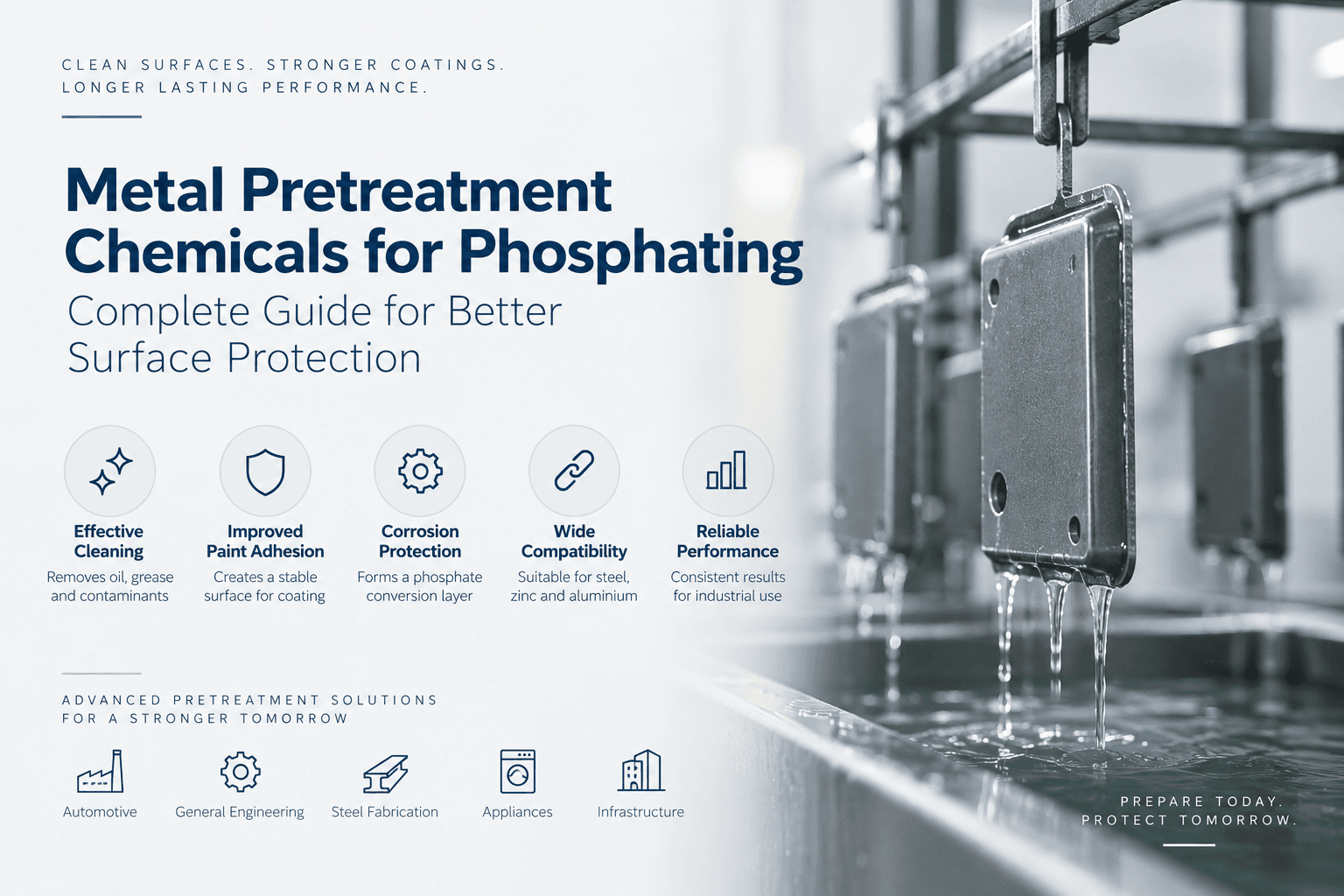
Metal surfaces rarely perform at their best when they move directly from fabrication to painting, powder coating or another finishing operation. Oil, grease, rust, dust, mill scale and other contaminants can remain on the surface after machining, forming or storage. These contaminants can weaken coating adhesion and create inconsistent finishing results. A controlled pretreatment process prepares the metal before the final coating stage and helps create a more stable base for long-term performance.
Metal pretreatment chemicals for phosphating play an important role in this preparation. Phosphating is a chemical conversion process that modifies the metal surface and creates a phosphate coating. The resulting surface can provide a better foundation for paint or other organic coatings while also contributing to corrosion protection. Modern pretreatment systems can be designed for steel, zinc-coated materials and aluminium, depending on the chemistry and process selected. Henkel describes zinc phosphating as a pretreatment that promotes paint adhesion and corrosion protection, with spray and immersion processes used across different substrates.
Adchem Industries has positioned metal pretreatment alongside its industrial adhesive portfolio. Its current website describes the business as a manufacturer of adhesives and metal pretreatment solutions, with manufacturing operations in West Bengal, more than four decades of experience, a modern laboratory and a dedicated R&D unit. Its website also identifies metal pretreatment chemicals as a distinct product category.
What Are Metal Pretreatment Chemicals for Phosphating?
Metal pretreatment chemicals for phosphating are used to prepare and condition metal surfaces before or during a phosphating process. The objective is not simply to make the metal look clean. The process creates a chemically suitable surface that can support the next finishing stage.
A typical pretreatment sequence can include cleaning, rinsing, derusting or pickling where required, surface conditioning, phosphating, another rinse and a final passivation or sealing step. The exact sequence changes according to the metal substrate, contamination level, phosphate system and downstream coating. Henkel notes that zinc phosphating involves initial cleaning followed by surface conditioning and phosphate deposition, with post-treatment used in some systems to reduce porosity and improve long-term adhesion and corrosion resistance.
The chemistry must therefore be selected as part of a complete process. Degreasers remove oils and process residues. Derusting chemicals address oxide and corrosion layers. Activators help promote suitable phosphate crystal formation. Phosphate chemistry creates the conversion layer, while passivation or sealing can improve subsequent protection.
Why Phosphating Matters Before Painting
Paint does not perform independently of the surface beneath it. A poorly prepared metal panel can develop adhesion failures even when the paint itself has been formulated correctly. Pretreatment creates a more suitable interface between the substrate and the coating.
Henkel states that zinc phosphate conversion coatings create a dense polycrystalline surface that provides a strong base for powder paint, electrocoat and liquid paint systems. The company also notes that zinc phosphate pretreatment can support corrosion resistance and paint adhesion across several substrates, including steel, galvanised steel, zinc alloys and aluminium.
Iron phosphating is another established route for ferrous substrates. Henkel describes iron phosphate treatment as a preparation method for painting or powder coating that removes contamination and creates a suitable bonding surface while helping inhibit subsequent corrosion.
The practical result is a better-prepared interface, more consistent coating behaviour and a lower risk of premature finishing defects.
Key Benefits of Metal Pretreatment
When the pretreatment chemistry, concentration, process conditions and rinsing stages are correctly controlled, a phosphating system can support several manufacturing objectives.
- ✓Improved paint and coating adhesion
- ✓Better corrosion resistance
- ✓More uniform coating performance
- ✓Improved surface cleanliness
- ✓Greater coating durability
- ✓Reduced risk of premature peeling
- ✓More consistent powder coating or liquid paint results
- ✓Better preparation for electrocoating and related finishing processes
- ✓Improved appearance of the final coated component
- ✓More predictable quality control
Henkel identifies paint adhesion and corrosion protection as two central purposes of zinc phosphate conversion coating. Its technical information also describes the value of uniform, dense phosphate layers and appropriate post-treatment.
The benefit becomes especially important when components face humidity, outdoor exposure, vibration, temperature changes or mechanical handling. A good pretreatment does not replace the final coating. It helps the coating perform from a better-prepared foundation.
The Basic Phosphating Process
A well-designed pretreatment line normally treats surface preparation as a sequence rather than a single chemical bath. Each stage has a clear role, and a problem in one stage can affect every step that follows.
1. Cleaning
The process first removes oil, grease, dirt and fabrication residues. Cleaning is essential because contaminants can interfere with phosphate formation. Henkel identifies cleaning as the first active stage of zinc phosphating.
2. Rinsing
A rinse removes residual cleaner and helps prevent contamination of the next bath.
3. Derusting or Pickling
Where rust, oxide or scale is present, an acidic preparation step may be required. Henkel describes pickling as a surface treatment that removes oxides, corrosion, weld discolouration and scale before subsequent operations.
4. Activation
A conditioning stage can help prepare the surface for a more uniform phosphate layer. Henkel explains that surface conditioners provide nucleation sites that promote fine, dense phosphate crystals.
5. Phosphating
The metal enters the phosphate bath by spray or immersion, depending on the system. A conversion coating forms on the surface.
6. Post-Treatment
A passivation or sealing stage may follow phosphating to reduce porosity and improve corrosion resistance and long-term coating performance.
Types of Phosphate Treatment
Different phosphate systems serve different engineering objectives. Selection depends on substrate, coating system, required corrosion protection, friction characteristics and production method.
| Phosphate System | Common Purpose | Typical Substrate Considerations |
|---|---|---|
| Iron phosphate | Surface preparation for painting or powder coating | Mainly ferrous surfaces, depending on chemistry |
| Zinc phosphate | Strong foundation for paint and corrosion protection | Steel, galvanised steel and selected mixed-metal systems |
| Manganese phosphate | Conversion coating for specialised engineering components | Iron and steel components where friction and wear behaviour matter |
| Zinc-calcium phosphate | Alternative conversion-coating route | Selected steel applications |
| Multimetal phosphate systems | Mixed-substrate processing | Steel, zinc-coated materials and aluminium, depending on formulation |
Henkel currently documents iron, zinc and manganese phosphating solutions for different industrial applications. Its information also shows that mixed-metal zinc phosphate processes may involve steel, galvanised steel, zinc-nickel alloys and aluminium.
The correct system should always be selected according to the substrate and final coating specification rather than by phosphate type alone.
Zinc Phosphating for Industrial Coating Lines
Zinc phosphating remains an important pretreatment technology where manufacturers need a robust base for subsequent paint or coating. The process creates a conversion layer rather than simply placing a removable chemical film on top of the metal.
Henkel explains that modern zinc phosphate coatings can contain phosphate phases associated with zinc and other metal ions, forming a polycrystalline coating that supports paint adhesion and corrosion resistance. Spray and immersion processes are both used.
The process begins with a clean surface. A conditioner can then encourage controlled phosphate crystal formation. The phosphate bath changes the chemical and physical characteristics of the surface before the component receives the subsequent coating.
For industrial manufacturers, the objective is consistency. Uneven cleaning, unstable bath chemistry or poor rinsing can produce a variable phosphate layer and inconsistent coating results.
This is why Metal pretreatment chemicals for phosphating should be evaluated as part of a complete pretreatment programme, not simply as isolated chemical products.
Iron Phosphating for Steel Components
Iron phosphating is often used where manufacturers need a comparatively straightforward pretreatment for painted or powder-coated ferrous components. It can combine surface preparation and conversion coating within a controlled process.
Henkel describes iron phosphate products that simultaneously clean and produce a thin iron phosphate coating on steel, aluminium and zinc surfaces in specific formulations. The company states that such treatment can provide a clean surface, inhibit corrosion and improve the adhesion and durability of subsequent paint finishes.
Iron phosphate can be useful where the production objective centres on paint preparation rather than the heavier conversion coatings required for some corrosion-critical applications.
The correct chemistry depends on contamination, substrate and coating system. A mild steel component with light fabrication oil has a different treatment requirement from a heavily scaled or corroded part.
Process engineers should therefore assess incoming surface condition before deciding on the pretreatment route.
Surface Conditioning and Phosphate Crystal Formation
Surface conditioning is an often-overlooked part of phosphate processing. Yet it can have a direct influence on coating quality.
Henkel explains that a conditioner applied before zinc phosphating provides nucleation sites for phosphate formation. This encourages a fine and dense microcrystalline structure rather than uncontrolled crystal growth.
A controlled crystal structure can create a more uniform platform for subsequent coating. The exact chemistry varies by substrate and phosphate system, so manufacturers should follow the technical instructions provided for their selected formulation.
Water quality can also influence chemical processes. Henkel notes that surface conditioner products are available for a range of water conditions, showing that bath management and process chemistry need to work together.
This illustrates a broader principle: pretreatment quality comes from process control, not from chemical strength alone.
Passivation After Phosphating
Passivation can be used after a phosphate conversion coating to improve the condition of the treated surface. The purpose is to control surface porosity and improve corrosion resistance before the final coating stage.
Henkel states that post-treatment and sealing can reduce phosphate-layer porosity and contribute to improved long-term adhesion and corrosion resistance. The company also offers chrome-free post-treatment technologies for specific conversion-coating applications.
The choice between traditional and newer passivation chemistry depends on the application, environmental requirements, substrate and coating specification.
Manufacturers should also consider wastewater treatment, bath control and regulatory requirements when designing the complete pretreatment line.
The chemistry should work with the entire system, from incoming metal cleaning through final rinse and drying.
Adchem Industries and Metal Pretreatment Solutions
Adchem Industries currently presents metal pretreatment chemicals as one of its major industrial solution categories alongside labelling and wood adhesives. Its website states that the business was established in 1984, operates from West Bengal, has manufacturing infrastructure spread over one acre and reports a production capacity of 4 tonnes per day.
Its quality system includes testing in a modern laboratory and a separate R&D unit for formulation development. The company describes its aim as supplying adhesives, coatings and packaging-related materials with application support and timely service.
The company's current website does not publish a detailed online list of every metal pretreatment formulation, operating parameter or bath specification. A current third-party product listing associated with Adchem Industries, however, identifies phosphating, derusting and degreasing chemicals among its industrial chemical products. That listing also references product families such as APDEG, APRUST, APHOX, ACTIVATOR and PASSEAL for different treatment functions.
For technical procurement, buyers should request the latest product-specific technical data directly from Adchem before specifying a formulation.
Adchem Product Range Listed for Metal Treatment
Third-party listings associated with Adchem Industries provide useful historical and commercial context for the company's metal-treatment portfolio. The listed range includes cleaners, derusters, activators, phosphate chemicals and post-treatment products.
Examples include:
- ✓APDEG-50: Listed as a water-soluble degreasing chemical for aluminium.
- ✓APDEG-60: Listed as a heavy-duty degreasing chemical for mild steel and iron.
- ✓APRUST-P: Listed as a phosphoric-acid and synthetic-detergent based derusting chemical.
- ✓ACTIVATOR-504: Listed as a surface activating and grain-refining chemical.
- ✓APHOX-ZC: Listed as an accelerated room-temperature zinc phosphating chemical.
- ✓APHOX-ZH: Listed as a zinc-calcium phosphating formulation for hot processing.
- ✓APHOX-ZW: Listed as a zinc-nickel phosphating chemical for wire drawing.
- ✓APHOX-M: Listed as a manganese phosphating chemical.
- ✓PASSEAL-87: Listed as a chrome-free passivation chemical used after phosphating.
- ✓APHOX-C 3S and APHOX-31: Listed as iron phosphating chemicals for mild steel.
These descriptions come from a third-party Adchem product listing rather than the company's current official product pages, so manufacturers should confirm current availability, formulation, specification and operating conditions directly with Adchem.
Applications Across Manufacturing Industries
Metal pretreatment supports many industries because painted, powder-coated or otherwise finished metal appears in a wide range of products.
A third-party listing associated with Adchem connects its metal treatment products with powder coating, liquid and stoving paints, furniture, wire products, nuts and bolts, fans, electrical components, automotive products and sanitary goods.
The technical requirement varies by application. A fastener manufacturer may require a different phosphate layer from a furniture manufacturer. An automotive component may need stringent corrosion protection and stable paint adhesion, while a general fabrication line may focus more heavily on economical coating preparation.
This makes application-specific formulation valuable.
A proper pretreatment system should be selected around the metal, fabrication process, contamination profile, finishing system and expected service conditions.
Common Problems Caused by Poor Pretreatment
Many coating failures begin before the coating is even applied. Poor pretreatment can leave contamination or create a surface that does not support consistent phosphate formation.
Common warning signs include:
- ⚠Peeling paint
- ⚠Blistering
- ⚠Flash rust
- ⚠Uneven phosphate deposition
- ⚠Poor powder-coating adhesion
- ⚠Surface staining
- ⚠Inconsistent coating thickness
- ⚠Excessive sludge or bath contamination
- ⚠Poor rinsing
- ⚠High reject rates
- ⚠Premature corrosion
Henkel emphasises that proper cleaning is essential before zinc phosphate deposition and that surface conditioning can influence the formation of dense, uniform phosphate crystals.
A manufacturing team should therefore investigate the entire pretreatment sequence when defects appear. Increasing phosphate concentration without correcting poor degreasing, rinsing or bath control may not solve the underlying issue.
Factors to Consider When Selecting Pretreatment Chemicals
The right formulation should match measurable production conditions. Procurement and process teams should review several factors before approving a chemical.
| Selection Factor | Why It Matters |
|---|---|
| Metal substrate | Steel, zinc and aluminium can require different chemistry |
| Contamination | Oil, grease, rust and scale influence cleaning requirements |
| Application method | Spray and immersion systems have different process characteristics |
| Operating temperature | Some formulations are designed for ambient or heated operation |
| Required coating | Powder, liquid paint and electrocoat may have different pretreatment needs |
| Corrosion requirement | Service environment influences conversion-coating choice |
| Bath control | Concentration, pH and contamination affect consistency |
| Rinsing quality | Poor rinsing can carry contaminants between stages |
| Post-treatment | Sealing may improve long-term corrosion performance |
| Environmental requirements | Chemical selection should consider wastewater and regulatory needs |
| Technical support | Process assistance helps reduce formulation and application errors |
Henkel's current technical portfolio demonstrates that spray and immersion systems, mixed-metal substrates and post-treatment requirements can all affect pretreatment selection.
Quality Control During Phosphating
Consistent pretreatment requires routine monitoring. Production teams should define acceptable process windows for the selected chemical system and track them throughout operation.
Useful control points can include bath concentration, pH, temperature, treatment time, rinse condition, contamination level and surface appearance. The exact control method should come from the chemical supplier's technical documentation.
Visual inspection also provides an early indication of process drift. Parts should show consistent preparation rather than unexplained stains, patchiness or uneven conversion coating.
The downstream coating should then be tested for adhesion and corrosion performance according to the manufacturing specification.
For Metal pretreatment chemicals for phosphating, quality control matters because chemical performance depends on both formulation and bath management. Even a technically suitable chemical can underperform if the process conditions are poorly controlled.
Safety and Responsible Chemical Handling
Phosphating chemicals, degreasers, derusters and related surface-treatment products can contain acidic, alkaline or reactive ingredients. Safe handling therefore requires appropriate industrial controls.
Manufacturers should follow the supplier's Safety Data Sheet, storage instructions, personal protective equipment requirements and emergency procedures. Chemical additions should follow the prescribed order, concentration and process method.
Ventilation, compatible tanks, spill control and wastewater management should also form part of the installation plan.
Responsible chemical management protects workers while also improving process stability. Poor storage, contamination between products or uncontrolled chemical additions can affect both safety and treatment performance.
For procurement teams, technical support should include safety documentation and current regulatory information relevant to the product and location.
Why Technical Support Matters
A pretreatment chemical is not a plug-and-play component. Its performance depends on metal type, bath chemistry, equipment, contamination and downstream coating.
A technically capable supplier can help determine whether the process needs stronger cleaning, a different activator, altered bath control or another phosphate chemistry. That support can shorten production trials and reduce costly experimentation.
Adchem Industries states that it maintains a separate R&D unit and a modern laboratory for product testing and formulation development. Its stated business objective also includes application support and timely service.
That technical orientation is particularly useful where customers process multiple metals or operate different coating systems.
The strongest supplier relationship combines product supply with practical process support.
Final Words
Metal pretreatment chemicals for phosphating form a critical part of surface preparation because the quality of the final paint or coating depends heavily on the condition of the underlying metal. Cleaning removes oil, grease and other contaminants. Derusting or pickling addresses corrosion and oxide layers where required. Surface conditioning prepares the metal for controlled phosphate formation, while the phosphating stage creates a conversion layer that can provide a suitable foundation for paint. A post-treatment or passivation stage can then help reduce surface porosity and improve corrosion resistance. This sequence shows why pretreatment should be treated as a complete process rather than a single chemical purchase.
Henkel's current technical guidance supports this process-based approach and documents zinc and iron phosphating as established methods for improving paint adhesion and corrosion protection.
For manufacturers evaluating Metal pretreatment chemicals for phosphating, the next consideration is supplier capability. Adchem Industries presents metal pretreatment as a dedicated product category alongside its established adhesive business. The company states that it has operated since 1984, maintains a one-acre manufacturing facility, reports production capacity of 4 tonnes per day and uses a modern laboratory and separate R&D unit for formulation development. A third-party Adchem product listing further associates the company with phosphating, degreasing and derusting chemicals, including APDEG, APRUST, APHOX, ACTIVATOR and PASSEAL ranges. Those third-party descriptions should be treated as commercial reference material rather than a substitute for the latest official technical datasheet.
Before selecting a formulation, buyers should confirm the present product grade, metal compatibility, process method, recommended concentration, temperature, bath control requirements and downstream coating system directly with Adchem Industries.
A properly selected pretreatment system can improve coating adhesion, reduce surface defects and contribute to longer service life. It can also make production more predictable because each component enters the painting or finishing stage with a controlled surface condition.
The most effective approach combines chemical selection with process discipline. Manufacturers should test representative parts, monitor the pretreatment bath, maintain effective rinsing and verify final coating adhesion and corrosion performance.
When these elements work together, phosphating becomes more than a cleaning step. It becomes a carefully controlled surface-engineering stage that helps the finished metal product perform reliably.
Ready to Upgrade Your Pretreatment Process?
Get a free consultation and sample kit tailored to your production line.